
Golf might not look like the most physically demanding sport, but an 18-hole round involves thousands of steps, repeated swings, bending down to pick up balls and a large amount of rotation through the hips, shoulders and upper body.
That is why spending just a few minutes warming up before your round can be worthwhile. A good pre-round routine can help you loosen up, increase blood flow and get your body ready for the movements involved in the golf swing. The American College of Sports Medicine recommends a dynamic warm-up before a round or practice session, particularly to help prepare the muscles and joints involved in the golf swing.
You do not need to spend 30 minutes stretching before every round. In fact, a simple five to ten-minute routine can be enough to get your body moving before you head to the first tee.
Why Should Golfers Stretch Before a Round?
The golf swing is a fast and rotational movement. Your hips, shoulders, upper back and core all need to work together to produce an effective swing.
If you arrive at the golf course after sitting in the car or at a desk for several hours, you may feel stiff before you have even picked up a club. Going straight from the car park to your first tee shot means asking your body to produce a powerful rotational movement without much preparation.
A warm-up gives you an opportunity to gradually get your body moving. It can also help you identify any areas that feel particularly tight before you start playing.
Rather than thinking about stretching as something that will suddenly make you play better, think of it as preparation for the physical demands of the round.
Dynamic Stretching Before Golf
Before a round, it is generally better to focus on dynamic movements rather than spending a long time holding deep static stretches.
Dynamic stretching involves moving through a comfortable range of motion rather than holding one position for a prolonged period. This is particularly useful before golf because it gets the hips, shoulders and torso moving in ways that are relevant to the swing.
Research and sports-medicine guidance do not suggest that there is one perfect stretching routine for every golfer, but dynamic warm-ups are commonly recommended before golf to increase movement and blood flow.
Here are some simple movements you can incorporate into your pre-round routine.
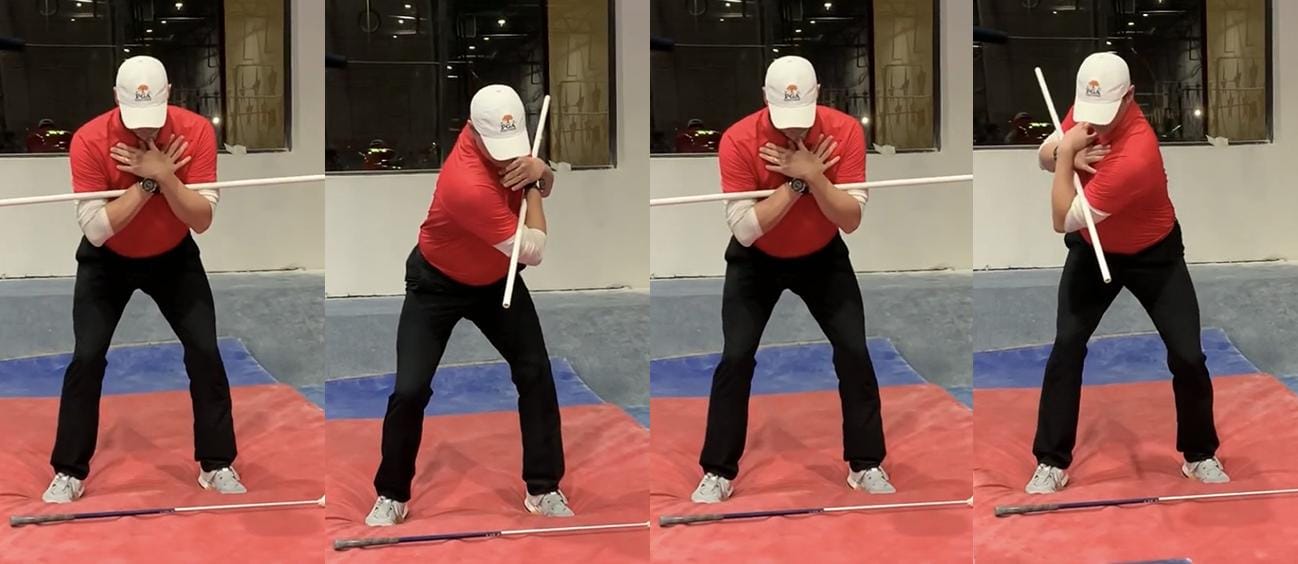
1. Torso Rotations
One of the most useful movements for golfers is a simple torso rotation.
Stand with your feet approximately shoulder-width apart and cross your arms across your chest. Keeping your lower body relatively stable, gently rotate your upper body from side to side.
The movement should feel controlled rather than forced. You are simply getting your upper back, shoulders and torso used to rotating before you start making full golf swings.
Try around 10 rotations each way, gradually increasing the range of movement as your body loosens up.
This is particularly useful because rotation is such an important part of the golf swing. Your body needs to turn during the backswing and then rotate through impact and into the follow-through.
2. Shoulder Rotations
Your shoulders are heavily involved throughout the golf swing, so getting them moving before you hit the range or first tee can be useful.
Stand upright and make large controlled circles with your arms. Start with smaller circles and gradually make them larger. You can then reverse the direction.
Another simple option is to hold your arms across your chest and gently open your chest by moving your elbows backwards.


Aim for around 10 circles in each direction, keeping the movement comfortable.
There is no need to force the shoulder beyond its natural range. The goal is simply to get the joint moving.
3. Hip Rotations
The hips play a major role in the golf swing and are particularly important for creating and transferring rotation.
Stand with your feet slightly wider than shoulder-width apart and place your hands on your hips. Make controlled circles with your hips, gradually increasing the range of movement.


Try 10 circles in each direction.
You can also incorporate gentle side-to-side movements to get your hips and legs moving before you start swinging.
For golfers who spend a lot of time sitting during the day, giving the hips some attention before playing can be particularly useful.
4. Leg Swings
Your legs might not be the first thing you think about when discussing the golf swing, but they play an important role in your stability and movement throughout the swing.
For a simple dynamic warm-up, stand next to your golf bag or a trolley for support. Swing one leg gently backwards and forwards, keeping the movement controlled. Repeat on the other leg.


Start with a small movement and gradually increase the range as the leg loosens up.
Around 10 swings on each leg is plenty for a pre-round routine.
You can also perform gentle side-to-side leg swings to work through a slightly different range of movement.
5. Walking Lunges With Rotation
Walking lunges can combine several useful movements into one exercise.
Take a comfortable step forward into a lunge position. As you lower yourself, gently rotate your upper body towards the front leg before returning to the starting position and repeating on the other side.


You do not need to perform deep lunges. The aim before golf is simply to get the legs, hips and torso moving.
Try 5 to 8 repetitions on each side.
This movement can be particularly useful if you have been sitting down for a long journey to the golf course.
6. Side Bends
Side bends are another simple movement that can help get your torso moving.
Stand upright with your feet around shoulder-width apart. Place one hand on your hip and gently reach the other arm over your head while leaning to the opposite side.
Return to the centre and repeat on the other side.


Keep the movement controlled and avoid forcing yourself into a deep stretch.
Around 5 to 10 repetitions on each side is enough before a round.
7. Gentle Hamstring and Calf Mobility
Your hamstrings and calves are also worth considering before an 18-hole round, particularly if you are walking the course.
Rather than immediately holding a deep hamstring stretch for a long period, try gentle dynamic movements first. You can hinge forwards from the hips while keeping your back comfortable, then return to an upright position.
You can also perform gentle calf raises, lifting your heels from the ground and lowering them slowly.


This gets the lower legs moving before you spend several hours walking around the course.
A Simple 5-Minute Golf Warm-Up
You do not need to complete every stretch in this article every time you play.
If you are short on time, try putting together a simple five-minute routine. Start with a couple of minutes of gentle walking to increase your body temperature, followed by torso rotations, shoulder circles, hip rotations and leg swings.
Once you feel more mobile, make a few gentle practice swings with a short club before gradually progressing to longer swings.
This is much better preparation than simply pulling the driver out of the bag and immediately trying to hit your longest shot of the day.
A golf warm-up should build gradually. Start with easy movements, then progress towards movements that look more like your actual golf swing.
Should You Stretch Before or After Golf?
There is a difference between preparing your body before golf and working on flexibility after your round.
Before golf, dynamic movements are a sensible way to prepare your body for activity. After your round, you can spend more time working on general mobility and flexibility if that is something you want to improve.
There is no need to force a stretch or try to achieve a particular level of flexibility immediately. Consistency is much more important.
If a particular movement causes pain rather than simply feeling like a stretch or mild muscular effort, stop the movement. Persistent pain or an existing injury is something to discuss with an appropriate healthcare professional rather than trying to stretch through it.
Don’t Forget the Golf Swing Warm-Up
Stretching is only one part of preparing for a round.
Once your body feels warm, your next step should be to gradually introduce golf swings. Start with small swings using a short club before progressing towards fuller swings.
This gives your body a chance to move from general warm-up exercises into the specific movements required for golf.
It also gives you an opportunity to get a feel for the day. Some days you might feel loose and ready immediately, while on other days you might need a little longer to get comfortable.
How Long Should a Golf Warm-Up Take?
For most recreational golfers, you do not need an elaborate routine.
Five to ten minutes of movement before your round is a realistic starting point. If you have more time, you can spend longer working on mobility and hitting some practice shots, but the key is consistency.
The important thing is not to view warming up as something that only professional golfers need to do. Whether you play off a single-figure handicap or are still trying to break 100, your body still has to perform the same basic movements during the golf swing.
Make Stretching Part of Your Golf Routine
Golf is often treated as a purely technical game, but the physical side should not be ignored. Your swing depends on your ability to rotate, maintain balance, move your hips and shoulders and repeatedly perform the same movement throughout an entire round.
You do not need to become a gym fanatic or spend hours stretching every morning. Simply arriving at the course a little earlier and spending five minutes getting your body moving can become a useful part of your normal golf routine.
The next time you play, rather than standing on the first tee feeling stiff and hoping your first drive warms you up, spend a few minutes preparing your body first.
Your first swing of the day does not have to be your warm-up.