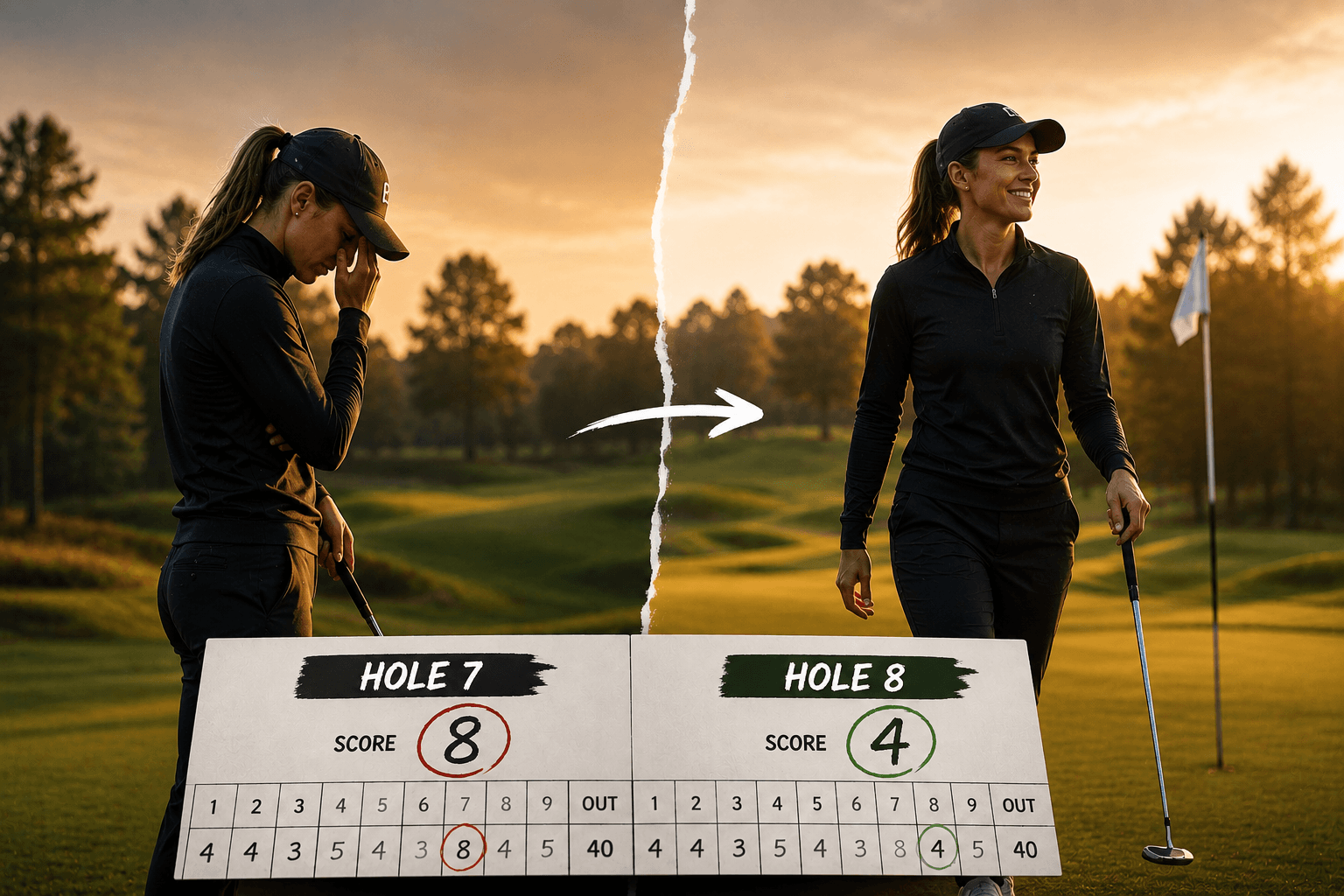
Every golfer knows the feeling. You have just walked off the green after a hole that you would rather forget. Perhaps you have made a triple bogey after finding the trees, lost a golf ball, missed a short putt or simply had one of those holes where nothing seemed to go your way.
The frustrating part is that the hole itself is only one part of the problem. What happens next can have a much bigger impact on your round.
Golf is as much a mental game as it is a physical one, and learning how to recover after a bad hole in golf is an important part of developing mental strength and resilience. One poor hole does not have to turn into several poor holes, and learning how to reset your mind can help you get your round back on track.
Why Does One Bad Hole Affect the Rest of Your Round?
It is easy to understand why a bad hole can be frustrating. You may have spent the first 10 or 12 holes building a good score, only to give several shots away in a matter of minutes.
The problem begins when you continue thinking about that hole after you have finished it. You might find yourself replaying the missed putt, the poor drive or the decision that led to the penalty. You then arrive at the next tee still thinking about what has already happened.
This is where the psychology of golf becomes so important.
The next hole has not changed, but your mindset has. Instead of concentrating on the shot in front of you, you are still mentally stuck on the previous hole. This can create more pressure and make you anxious about making another mistake.
Before you know it, one bad hole has started to affect your entire round.
Accept That Bad Holes Are Part of Golf
The first step towards recovering from a bad hole is accepting that bad holes happen.
Nobody plays perfect golf. Even the best players in the world hit poor drives, miss short putts, find hazards and occasionally post a score they are not happy with.
As an amateur golfer, expecting yourself to avoid every mistake is unrealistic. Golf is an unpredictable game, and sometimes you simply have a hole where everything seems to go wrong.
The important thing is not whether you make mistakes. It is how you respond to them.
Once you have finished the hole, the score is already on your card. There is nothing you can do to change it. Spending the next few holes being angry about it will not give those shots back.
Accept what happened, learn from it later and concentrate on what you can still control.
The Hole Is Finished, So Leave It Behind
One of the most useful habits you can develop is learning how to mentally separate one hole from the next.
Once you walk away from the green, try to draw a line underneath what has happened. Remind yourself that the hole is finished and the next one is a fresh opportunity.
This can be particularly important if you have made a high score.
You might have just made a seven or eight, but the next hole still starts at level par. You have not suddenly become a worse golfer because of one score.
Your scorecard remembers what happened. You do not need to keep thinking about it.
Don’t Try to Win the Shots Back Immediately
After a bad hole, it is very tempting to try to get those shots back straight away.
Imagine you have just made a triple bogey. You arrive at the next tee and decide that you need to make a birdie to get your round back on track. Suddenly, you are taking on a shot you would normally avoid or aiming at a difficult pin because you feel like you need to be aggressive.
This is where things can quickly get worse.
Instead of trying to recover everything immediately, return to the way you were playing before the bad hole. Make sensible decisions, choose realistic targets and play the hole in front of you.
You do not need to win the shots back on the very next hole. Your only job is to play the next shot as well as you can.
Focus on the Next Shot
A major part of the mental game of golf is learning to stay in the present.
After a bad hole, your mind may start looking too far ahead. You might begin thinking about the score you need, how many shots you have lost or what you need to do on the final few holes.
While these thoughts are understandable, they are not going to help you hit your next golf shot.
Instead, bring your attention back to what is directly in front of you. Look at the lie, consider the distance, check the conditions and decide where you want the ball to go.
Then choose your club, commit to your decision and play the shot.
Once that shot is finished, repeat the process.
Golf becomes much easier mentally when you stop trying to play the entire round in your head and concentrate on the shot you are actually playing.
Use Your Pre Shot Routine to Reset
Your pre shot routine can be particularly useful after a bad hole because it gives you something familiar to focus on.
Rather than standing over the ball thinking about the mistake you have just made, go through the same routine you would normally use. Assess the shot, choose your target, select your club and take a practice swing if that is part of your routine.
Then step into the shot, take one final look at your target and commit.
Having this process to fall back on can help create consistency when your mind is unsettled.
Your routine will not guarantee a perfect shot, but it can help stop frustration and negative thoughts from taking over.
Take a Moment to Breathe
Frustration can cause golfers to rush.
You may walk quickly to the next tee, grab your driver and immediately start thinking about what went wrong. Instead, give yourself a moment.
Take a slow, controlled breath and allow yourself to reset before starting your next shot.
This does not need to be complicated. Sometimes simply slowing down for a few seconds can prevent you from carrying the frustration of the previous hole into the next one.
The aim is to arrive at the next shot with a clear mind rather than trying to hit the ball while still feeling angry.
Don’t Start Changing Your Golf Swing
Another common reaction to a bad hole is immediately trying to fix your golf swing.
You hit a poor drive and suddenly start changing your grip. You miss a putt and start questioning your putting stroke. You hit an iron poorly and begin thinking about your backswing.
Unless you have a genuine technical issue that you have been working on, changing your swing halfway through a round is rarely the answer.
Golf swings are not perfect every time. A poor shot does not necessarily mean that something is fundamentally wrong with your technique.
Trust the work you have already put into your game and focus on making a good decision with your next shot.
Change the Conversation in Your Head
The way you talk to yourself after a bad hole can have a surprisingly big impact on your round.
It is easy to start thinking things such as, “I’m playing terribly,” “I’ve ruined my round” or “I’m going to keep playing badly.”
These thoughts can create even more negativity and make the next shot feel more important than it actually is.
Instead, try to keep your self talk simple and realistic.
You do not need to convince yourself that you are going to shoot the best round of your life. Simply remind yourself that the previous hole is finished and that you still have plenty of golf left to play.
Something as simple as “Forget that hole, focus on the next shot” can help change your mindset.
Mental Resilience Means Recovering From Mistakes
Mental resilience in golf does not mean that you never get frustrated. It means that you learn how to recover when things go wrong.
Golf gives you plenty of opportunities to practise resilience. You will lose balls, miss putts, hit poor drives and occasionally make a score that leaves you wondering what happened.
The mentally strong golfer is not necessarily the golfer who makes the fewest mistakes. It is often the golfer who is able to recover from those mistakes without allowing them to affect everything that follows.
A bad hole is a setback, not the end of your round.
Learn From the Bad Hole After Your Round
There is a big difference between dwelling on a mistake and learning from it.
While you are still playing, your priority should be moving forward. However, once your round is finished, it can be useful to look back at what actually happened.
Was the problem caused by an aggressive decision? Did one poor shot lead to another? Did frustration cause you to rush? Did you take on a shot that you did not need to?
Looking at the situation calmly after the round can help you identify patterns in your game.
Perhaps you regularly try to recover too quickly after a bad shot. Maybe you take unnecessary risks when trying to make up lost shots. Understanding these patterns can help you make better decisions in future rounds.
This is how a bad experience can eventually become an opportunity to improve.
Remember How Quickly Golf Can Change
One of the best things about golf is that a round can change incredibly quickly.
You can make a triple bogey and then hit a brilliant drive on the next hole. You can miss a short putt and then hole a long one a few minutes later. You can have several poor holes and suddenly find your rhythm again.
This is why you should never assume that one bad hole has ruined your round.
Golf is made up of 18 holes, and every hole gives you another opportunity.
You never know what the next few holes might bring.
Final Thoughts on Recovering After a Bad Hole
Learning how to recover after a bad hole is one of the most valuable mental skills you can develop as a golfer.
You are never going to eliminate mistakes from your game. Bad drives, missed putts, lost balls and high scores will happen. What you can improve is how you respond when they do.
Developing mental strength, resilience and a positive golf mindset can help you stop one mistake from becoming several.
The next time you walk off the green after a hole you would rather forget, take a breath and accept what has happened. Do not try to win the shots back immediately and do not start changing your swing. Simply return to your normal routine and focus on the next shot.
The hole is finished. Your round isn’t.